Do Good Youth Soccer Players Translate to Good College Soccer Players?
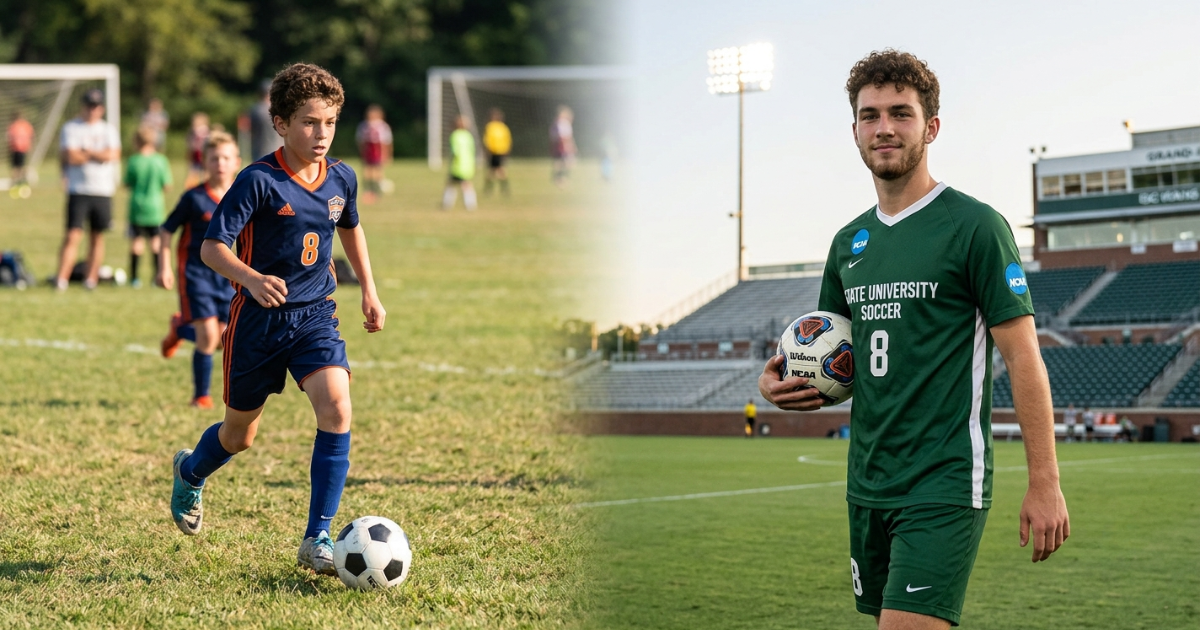
Not always. Being the best on your club team doesn’t guarantee you’ll even make a college roster. The traits that make you dominant at 14 aren’t always the ones that matter at 19. Some youth stars fade. Some late bloomers explode. Here’s what actually carries over (and what doesn’t).
Why Youth Dominance Doesn’t Guarantee College Success
A lot of youth success comes down to physical maturity. The kid who’s 5’10” in eighth grade while everyone else is 5’4″ scores a ton of goals. But that edge disappears the second everyone catches up.
By college, the physical gap closes pretty quickly. Now it’s about who developed real skill, soccer IQ, and work rate while they were busy relying on being bigger. The early bloomer who coasted often gets passed by the kid who had to figure out how to win without size.
Think of it this way: youth soccer rewards right now. College soccer rewards what you built.
What Actually Translates
Some things do carry over — and coaches recruit for exactly these:
- Soccer IQ. Reading the game, making the right decision under pressure, knowing where to be before the ball gets there. This scales at every level.
- Technical skill under pressure. Not just fancy touches in warmups — clean first touch and passing when a defender is breathing down your neck.
- Work rate and mentality. Coaches can teach tactics. They can’t teach a kid who refuses to stop competing.
- Coachability. The player who takes feedback and adjusts beats the more talented player who thinks they know it all. Every time.
- Consistency. One highlight goal doesn’t get you recruited. Doing your job every single game does.
Notice what’s not on that list: being the fastest, being the biggest, or scoring the most goals against weaker competition.
The Late Bloomer Advantage
Here’s the part nobody tells you. A lot of college contributors weren’t youth phenoms. They were the players who kept improving while the “can’t-miss” kids plateaued.
Why? Because they never got to rely on a shortcut. They had to develop real tools to compete. And development is a slope, not a snapshot. A coach doesn’t care how good you were at 13 — they care about your trajectory and your ceiling.
If you’re not the star right now, that’s not a death sentence. It might actually be your edge.
What This Means for Your Recruiting
Stop measuring yourself against who’s winning today. Start building the things that matter at the next level.
That means:
- Compete against better players whenever you can. Getting humbled is how you grow.
- Fix your weaknesses instead of hiding them. Two-footedness, defending, aerial ability — attack what’s holding you back.
- Track your own progress, not just your stat line. Are you better than you were three months ago?
- Get your game in front of the right coaches at the right level. Talent nobody sees doesn’t get recruited.
The goal isn’t to be great at 15. It’s to still be climbing at 18 — and to make sure college coaches are watching when you do.
That last part is where a lot of good players get stuck. You can be developing the right way and still get overlooked simply because no coach knows you exist. That’s exactly why we built Ninety — to help you find the right-fit programs, get your info in front of college coaches, and take control of your own recruiting instead of hoping you get spotted. Start building your list and reaching out at go90.io.

About the Author
Beau is the founder of Ninety (go90.io), a college soccer recruiting platform built exclusively for high school boys. A soccer dad who navigated the recruiting process firsthand with his son — an MLS NEXT player — he built Ninety to be the resource he wished he had. Beau also ran SoccerNovo and has a passion for building web apps that solve real problems. He writes about college soccer recruiting to help players and families cut through the noise and recruit with confidence.