What it Really Takes to Get Recruited for Soccer in 2026
If you’re a junior or senior in 2026 hoping to play college soccer, here’s the hard truth: the talent pool has never been deeper, the roster spots have never been fewer, and coaches have never been pickier.
But players are still getting recruited every single day — they’re just the ones doing the right things at the right time.
This guide breaks down exactly what those things are.
Why 2026 Is the Hardest Year to Get Recruited — Maybe Ever
The landscape flipped. Under the new NCAA rules rolling out from the House v. NCAA settlement, Division I men’s soccer programs now carry a hard roster cap of 28 players. Combine that with a transfer portal that had over 3,500 men’s and women’s soccer players moving around in the last cycle, and what you get is a massive traffic jam at the top.
Coaches are using portal transfers — guys who are 20, 21, 22 years old with college film already — to fill spots that used to go to high school seniors. As one New England Soccer Journal analysis of the 2026 class put it, the transfer portal, the rise of international students, and the growth of MLS Next have completely reshaped how coaches build rosters.
The numbers back it up.
Of the 450,000+ boys playing high school soccer in the U.S., only about 6% will play NCAA soccer at any level — D1, D2, or D3 combined. Only 1.4% make it to D1. And in 2026, that 1.4% is squeezed tighter than ever.
Translation: if you’re waiting until senior year to “get seen,” you’re already behind a 22-year-old with three years of college starts.
Start Earlier Than You Think (Seriously)
The old timeline — dominate junior year, send film senior fall, take visits — is dead. Coaches are now building their 2028 and 2029 classes while your 2026 class is still sorting itself out.
Here’s what an actually realistic timeline looks like now:
- Freshman year: Lock in academics (coaches need you eligible), play at the highest club level you can handle, and start learning what MLS Next, ECNL, and USL Academy are. No emails yet — just build the foundation.
- Sophomore year: Start building your highlight film. June 15 after sophomore year is the NCAA date when D1 coaches can legally start direct contact with you. Be ready to respond with a profile, video, and transcript the same day.
- Junior year: This is your primary recruiting window. Visit campuses starting August 1. Attend ID camps at schools you’re genuinely interested in. Get on coaches’ boards. Any kind of visibility is key.
- Senior year: If you’re still uncommitted in the fall, pivot fast — look seriously at D2, D3, NAIA, and strong junior college programs. Many players now take a “development year” with a prep program or post-grad year to re-enter the cycle stronger.
Your Highlight Video Is Your Resume (Don’t Screw It Up)
Coaches get hundreds of emails a week. They’ll decide whether to keep watching your video in the first 30-60 seconds. That’s your job interview.
What actually works in 2026:
- Length: 3 to 5 minutes, max. Put your 5 best clips first.
- Identify yourself: Arrow or spotlight on you in every clip. Coaches can’t read jersey numbers, and they won’t work to find you.
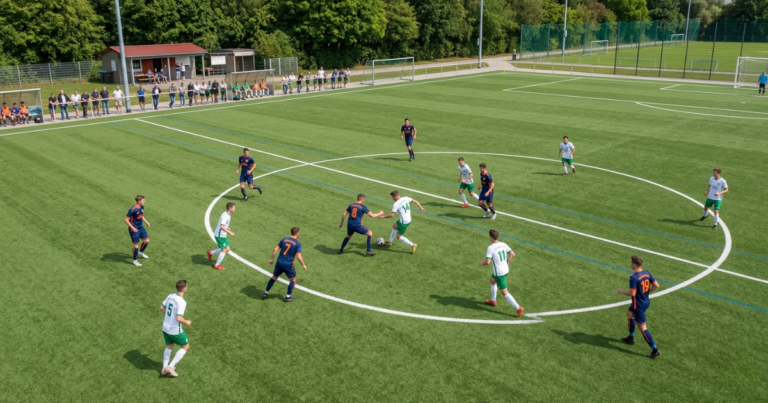
- Wide angles over tight zooms: Coaches want to see your decision-making, off-ball movement, and spacing — not just the goal. Keep the frame wide enough to see how you read the game.
- Show both feet, defending, and off-ball runs. One-footed players who only chase goals are a red flag.
- Skip the music. Coaches watch on mute. Nobody got recruited because of the beat drop.
- Title it professionally: “Jake Rivera | Class of 2027 | Center Mid | Highlights 2027”
- Use an unlisted YouTube link. Coaches forward these to their staff. If it’s private or password-protected, they move on.
Follow up with full-match film if a coach shows interest. Highlights get you in the door; full games are what get you an offer.
Write Emails Coaches Will Actually Open
Cold email is still the #1 way most players get on a coach’s radar. But 90% of recruits do it wrong.
The subject line that works: “2027 CB | 6’1″ | 3.8 GPA | Highlight Link”
The subject line that gets deleted: “Interested in your program”
A good email is 5-6 sentences, addresses the coach by name, shows you actually know their program (mention a result, a formation, a recent win), includes your academic info, links your video, and lists when they can see you play live. End with a specific ask — an ID camp date, a phone call, a school visit. Never send the same email to 50 schools. Coaches can smell a copy-paste from a mile away.
And email every assistant on the staff, not just the head coach. Assistants are usually the ones running recruiting.
Play Where Coaches Actually Look
In 2026, the leagues that matter most for boys are:
- MLS Next — the top developmental league, scouted heavily by D1 programs and MLS academies.
- ECNL Boys — deep talent pool, massive college coach attendance at showcases.
- USL Academy — rising fast, now a real recruiting pipeline.
If you’re not in one of these, that’s okay — but you need to get to the right showcases. The ECNL National Events, MLS Next Cup, Jefferson Cup, and Disney Showcase are where coaches cluster. One good weekend in front of 50 coaches beats six months of regular-season games.
Pro tip: tell coaches exactly which tournament, game, and field number you’ll be at before you get there. Don’t assume they’ll find you.
Academics Are Now Your Secret Weapon
With roster spots shrinking, academic aid has become the most underrated path to paying for college soccer. Under the new House settlement rules, D1 men’s soccer programs that opted in can now offer up to 28 scholarships across a 28-player roster — a massive jump from the old 9.9 limit. But here’s the catch: soccer is still an equivalency sport, meaning those scholarships can (and usually will) be split into partials. Schools aren’t required to fund all 28, and most won’t. Programs that didn’t opt into the settlement are still capped at 9.9.
Translation for you: the “full ride” is rarer than ever, and partial offers of 20-40% are the norm. That’s where academics come in. A 3.7 GPA and a 1350 SAT can unlock 50-75% academic scholarships at strong D3 and NESCAC programs — often making them cheaper than a partial athletic offer at a mid-major D1. Keep your grades up. It’s the cheat code.
Be Realistic About Your Level (It’s a Feature, Not a Bug)
The players getting recruited in 2026 are the ones who honestly assessed where they fit. D3 soccer is stronger than it’s ever been — the top 10% of D3 programs could compete with bottom-tier D1s on any given day.
Ask your club coach and high school coach for an honest level assessment. Watch games at schools you’re targeting. If you’re not starting for your high-level club team, you’re probably not a Power 4 recruit — and that’s fine. A starting spot at a great D2 or D3 program beats four years riding the bench at a D1.
Actionable Checklist: Do These 7 Things This Month
- Record or update your highlight video (3-5 minutes, you spotlighted, wide angles).
- Build a one-page player profile: position, height, weight, graduation year, GPA/SAT, club, high school, coach contacts, video link. Check out Ninety’s examples.
- Make a target list of 25-40 schools across D1, D2, D3, and NAIA.
- Email every coach on staff at your top 10 schools this week.
- Register for two ID camps at schools you actually like (not just the famous ones).
- Clean up your social media. Coaches check every time.
- Nail your next report card. Academics are leverage.
The 2026 recruiting cycle is brutal, but it’s not hopeless. The players who get recruited now aren’t always the most talented — they’re the ones who start early, communicate professionally, and stay realistic about fit. Do the work most players won’t, and you’ll find yourself on a roster next fall.
Ready to take the guesswork out of getting recruited? Ninety (go90.io) is built for high school soccer players navigating exactly this process — connect with the right coaches, build a profile that gets opened, and get on the radar of programs that fit you. Sign up and start building your recruiting future today.
Frequently Asked Questions
A lot harder at the D1 level. The 28-player roster cap plus a transfer portal full of 20- to 22-year-olds with college film means fewer spots for high school seniors. D2, D3, and NAIA are still wide open if you start early and play your level.
No, but it certainly helps. Those leagues bring coaches to you. If you’re not in one, you’ll need to make up ground at showcases — and make sure coaches know exactly when and where to watch you play.
Very rare. Even with new House settlement rules allowing up to 28 scholarships at opted-in D1 programs, soccer is still an equivalency sport — meaning offers usually come as partials. Most families end up combining athletic and academic aid to make it work.

About the Author
Beau is the founder of Ninety (go90.io), a college soccer recruiting platform built exclusively for high school boys. A soccer dad who navigated the recruiting process firsthand with his son — an MLS NEXT player — he built Ninety to be the resource he wished he had. Beau also ran SoccerNovo and has a passion for building web apps that solve real problems. He writes about college soccer recruiting to help players and families cut through the noise and recruit with confidence.